
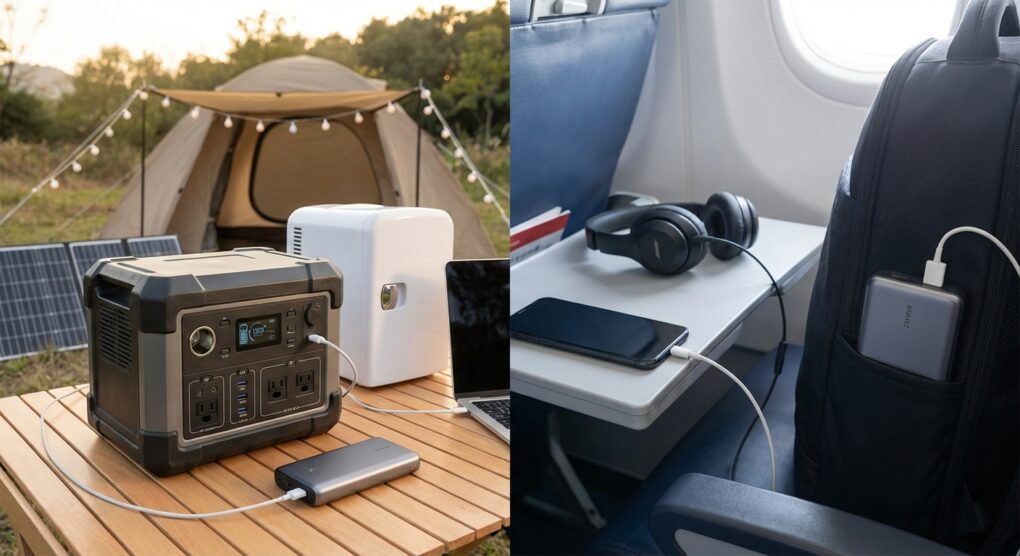
The only thing I hate more than a poorly documented API is a poorly labeled battery box. People walk into a store, see a small brick labeled “20,000 mAh,” and then see a large plastic box labeled “500 Wh,” and they think the difference is just size. They try to run their monitor and modem off the small one, and then they wonder why it dies in ten minutes. The truth is that these two categories of device are fundamentally different animals designed for different voltage tiers. mAh (milliamp-hours) is the unit of liars and smartphone chargers. Wh (Watt-hours) is the unit of actual, usable energy. You need to know the difference before you spend $800 on a box that can’t run your CPAP machine properly.
Why mAh is a Unit of Liars
The difference comes down to the Inverter. A power bank (the small brick) is designed to output low-voltage DC power—5V for standard USB, 9V/12V/20V for Power Delivery (PD). Power banks measure capacity in mAh at the internal cell voltage, which is 3.7V. Because the device has to boost that 3.7V up to 5V or 20V, you lose 30-40% of the rated capacity to heat and inefficiency. A 20,000mAh power bank gives you maybe 13,000mAh usable, low-voltage power. It is useless for anything that plugs into a wall outlet.
A Portable Power Station (the big box) measures capacity in Wh (Watt-hours). Wh is the universal unit of energy. It is capacity times voltage ($Wh = Ah \times V$), and it gives you the true energy potential of the battery. More importantly, the power station has a crucial component the bank doesn’t: an Inverter. The inverter takes the internal DC voltage and converts it to 120V AC, allowing you to plug in real devices—fridges, monitors, routers, and lamps. This conversion also costs energy, but the output is fundamentally more versatile.
The How-To: Choosing Your Capacity Based on Appliance
You choose based on what you need to run. If it has a plug, you need a power station. If it has a USB port, you can use a power bank. I use a simple wattage tiering system.
Tier 1: Personal Electronics (Power Bank Territory)
These devices run purely on DC power and charge via USB. You are measuring your need in charges, not hours.
- Devices: Phones (15-25W), Tablets (30W), Small Laptops (45-65W).
- Capacity Check: Look for 20,000 mAh to 26,800 mAh. Crucially, ensure the bank supports at least 65W Power Delivery (PD) output. Anything less, and your laptop will charge slower than it drains. I prefer 100W PD output so it can handle a full-size workstation.
- Use Case: Air travel (max size allowed is 26,800mAh/100Wh), day trips, keeping your modem alive for one hour during a power flicker.
Tier 2: Home Backup/Camping (Power Station Territory)
These devices require wall current (AC) or high-wattage DC, and you need capacity measured in Watt-hours.
I always look at the required running wattage of the device:
- Router/Modem (20W): A 300Wh station will run this for about 12-15 hours.
- Full-Size Monitor/PC (150W): A 500Wh station will run this for roughly 2.5 hours.
- CPAP Machine (50W): A 500Wh station runs this for over 8 hours (a full night).
Dirty Formula: Take the Power Station’s Wh rating, multiply it by 0.8 (accounting for inverter loss), and divide by the appliance wattage. ($Hours = (Wh \times 0.8) / Watts$). If you need to run essential gear for 8 hours, you need at least a 500Wh unit, and I always round up to 1000Wh just for safety.
Crucial Feature Check: The Inverter Quality
This is the most overlooked spec, and the one that separates a professional piece of equipment from a cheap toy. It is the quality of the AC output.
- Pure Sine Wave (PSW): This is what the wall outlets in your house deliver. It’s a clean, smooth, reliable electrical current. You need this for anything with a motor, a sensitive logic board, or anything medical (like a CPAP machine or laser printer). Always buy a power station with a Pure Sine Wave Inverter.
- Modified Sine Wave (MSW): This is a choppy, stepped approximation of wall power. It’s cheap to manufacture. MSW generators cause buzzing noises in audio equipment, run motors inefficiently, and can actually damage power bricks for sensitive electronics. I once bought a cheap station with a modified sine wave inverter, and it fried the power brick for my laser printer. Never buy MSW.
Typical issues
The Airline Limit (100Wh)
If you fly, you need to think in Wh, not mAh. The FAA/TSA limit for lithium-ion batteries in carry-on luggage is 100Wh. Most 26,800mAh power banks are exactly 99Wh. Any power station above this threshold—which is every model over 300Wh—is banned from the plane, even in checked luggage. Do not risk it. For travel, stick to the 26,800 mAh / 100Wh limit, and verify the rating is clearly printed on the device itself.
Recharge Time Paralysis
A large power station is useless if it takes a day to recharge. A 1000Wh station might take 10-12 hours to recharge from a standard 120W wall outlet. Look for stations that support fast charging (e.g., 500W AC input) or simultaneous solar/AC input. If you are preparing for a multi-day outage, you need to recharge that station quickly so it’s ready for the next cycle.
Ignoring the Running vs. Peak Wattage
Appliances like coffee makers or microwaves have a low average wattage but a massive surge on startup. Your 500Wh power station might have a 500W continuous output, but if your coffee maker draws 1,500W for three seconds when heating the water, the station will instantly trip its overload protection and shut down. Always check the Peak/Surge Wattage specification on the power station; it needs to handle the temporary spike.
Buy a power bank for your phone, buy a pure sine wave power station for anything that plugs into the wall, and always calculate your usable energy in Wh.